2026 Retirement Contribution Limits Explained
Retirement savers have new opportunities in 2026, with higher contribution limits and updated tax rules affecting 401(k)s, IRAs, and SIMPLE IRAs. Knowing how these changes apply to your situation can help you strengthen your long-term financial strategy.
As a new year begins, many savers want to know one thing: how much can you contribute to your retirement accounts in 2026? Contribution limits, income phase-outs, and tax rules change regularly, and understanding these updates can make a meaningful difference in long-term financial planning.
The latest updates affect IRAs, Roth IRAs, 401(k)s, SIMPLE IRAs, standard deductions, and even certain enhanced tax benefits for older taxpayers. Below is a comprehensive breakdown of the key changes for 2026 and what they could mean for your retirement strategy.
IRA and Roth IRA Contribution Limits for 2026
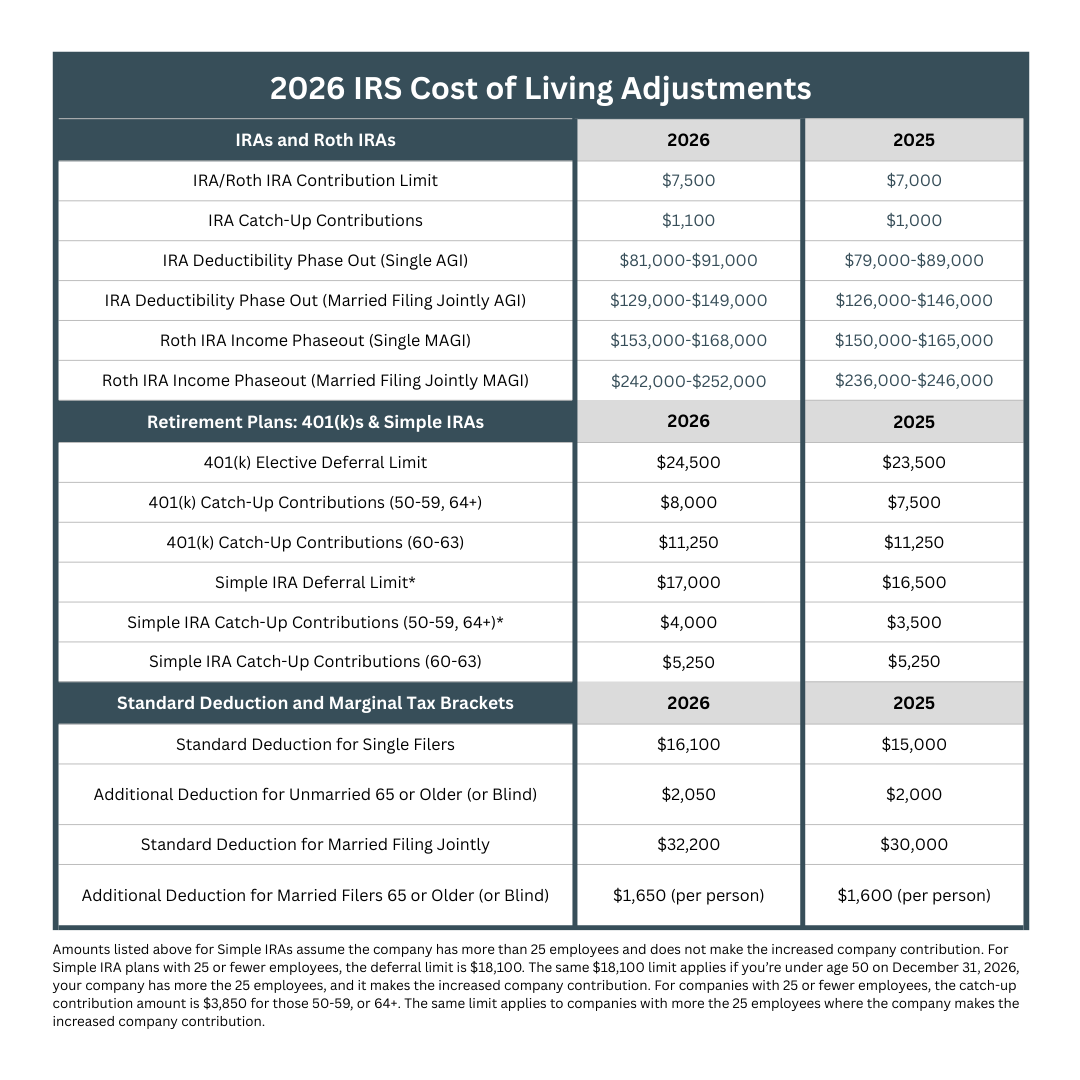
Individual Retirement Accounts saw a significant increase in allowable contributions (on a percentage basis). For 2026, Individuals under age 50 can contribute up to $7,500 across traditional and Roth IRAs combined, up from just $7,000 in 2025. Those age 50 and older can contribute up to $8,600, thanks to catch-up provisions, up from just $8,000 in 2025.
It’s important to remember that these limits are aggregated. This means contributions to a traditional IRA and a Roth IRA count toward the same annual cap. For example, someone under 50 could split contributions between both account types, but the total cannot exceed $7,500.
Before contributing to an IRA or Roth IRA, it’s also important to know that you must have enough earned income to cover the contributions. If you’re married filing jointly, income from one spouse can be used to cover contributions to both spouse’s IRAs. However, all deductible IRA and Roth IRA contributions are subject to income limits.
Roth IRA Income Phase-Outs
Eligibility for Roth IRA contributions depends on the following modified adjusted gross income (MAGI) limits.
For single filers in 2026, MAGI must be below $153,000 for a full contribution. For MAGI between $153,000 and $168,000, partial contributions can be made. However, for those with MAGI over $168,000, no Roth IRA contributions are allowed.
For married couples filing jointly, full contributions are allowed up to $242,000 of Modified Adjusted Gross Income. Partial contributions are permitted from $242,000-$252,000, and contributions are completely phased out above $252,000.
Traditional IRA deductions also depend on income levels and whether a workplace retirement plan is available, which can make planning more nuanced.
401(k) Contribution Limits and Catch-Up Rules
Allowable contributions for employer-sponsored retirement plans are also growing in 2026. The maximum employee deferral amount for individuals under 50 is $24,500 in 2026, up from $23,500 in 2025. For those who will attain age 50 or older in 2026, catch-up contributions are also allowed.
Catch-up provisions vary based on age:
- Ages 50–59: Additional $8,000 allowed
- Ages 60–63: “Super catch-up” of $11,250
- Ages 64+: Catch-up reverts to $8,000
This structure creates a unique window where individuals between ages 60 and 63 can contribute significantly more than both younger and slightly older peers.
Mandatory Roth Catch-Up Contributions
One of the biggest changes tied to SECURE Act 2.0 is that catch-up contributions must be made into Roth 401(k) accounts in 2026. These contributions are made with after-tax dollars rather than pre-tax income, potentially impacting both current tax liability and future retirement withdrawals.
Plan administrators typically handle this adjustment automatically, but it’s a change worth understanding when reviewing paychecks or retirement contributions.
SIMPLE IRA Contribution Rules for 2026
Despite the name, SIMPLE IRAs have become more complex due to updated legislation and new catch-up structures.
The basic SIMPLE IRA employee contribution limit is $17,000. Those age 50 to 59 or age 64 and older can save an additional $4,000 as a catch-up contribution. Those age 60 to 63 can save $5,250 as a “super” catch-up contribution. Under the Secure Act 2.0, employees of companies with 25 or fewer employees may now contribute more than the basic limits. For these employees, the contribution limit is $18,100. The catch-up limit is $3,850 for those age 50 to 59 or age 64 and older but remains $5,250 for those age 60 to 63. See this link for more information.
Because the rules vary depending on employer size and contribution structures, many participants find it helpful to confirm their specific limits before maximizing contributions.
Standard Deduction Changes for 2026
There were increases to the standard deduction in 2026, increasing the single filer standard deduction to $16,000, up from $15,000 in 2025, and the married filing jointly standard deduction to $32,200, up from $30,000 in 2025. Additional deductions for those married and over age 65 increased to $1,650 per person, while single filers over age 65 will receive an additional $2,000.
On top of the already increased standard deductions, seniors (65 and older) could also receive an Enhanced Senior Deduction in 2026. The additional deduction is $6,000 per person but phases out for single filers starting at $75,000 (MAGI) and for joint filers starting at $150,000.
For many retirees or near-retirees, these expanded deductions may significantly reduce taxable income.
Marginal Tax Brackets and Inflation Adjustments
While the number of federal tax brackets remains unchanged, income thresholds have shifted upward due to inflation adjustments. This means some taxpayers may remain in lower tax brackets even if income rises modestly.
Why These Changes Matter for Retirement Planning
Understanding contribution limits is more than a numbers exercise — it’s a strategic opportunity. Increased limits allow savers to accelerate retirement funding, especially during peak earning years.
Key takeaways for 2026 include:
- Higher IRA and 401(k) limits create more room for tax-advantaged savings.
- Age-based catch-up rules offer unique windows for boosting contributions.
- Roth requirements for catchups may shift tax planning strategies.
- Expanded deductions could improve after-tax income and savings capacity.
For many individuals, the most important question isn’t just how much they can contribute — but how much they should contribute to stay on track for retirement goals.
Final Thoughts
The 2026 retirement and tax updates bring both opportunities and complexity. From super catchups in workplace plans to evolving SIMPLE IRA rules and enhanced deductions for older taxpayers, staying informed can help investors make more confident decisions.
Whether you’re early in your career or approaching retirement, reviewing contribution limits annually is an important step toward building a resilient long-term financial strategy.
Want more help? Let’s chat.

Joe Allaria, CFP®
Wealth Advisor | Partner

Follow me on Social Media